
Bank results announced this week for the July-September quarter, including those from Axis Bank and ICICI Bank, are full of short forms such as NII, NIM, NPA and CASA. Each one answers a simple question about how a bank makes money, how safe its loans are and how cheaply it funds itself.
What happened
Axis Bank reported a net profit of ₹7,003 crore for the second quarter of FY27, up 38% from about ₹5,090 crore a year earlier, according to Business Today. ICICI Bank’s profit rose 20% to ₹14,843 crore, NDTV Profit reported. Those two sets of numbers are a handy way to see the terms in practice.
The four terms, one by one
Net interest income (NII)
NII is the interest a bank earns on loans and investments minus the interest it pays on deposits. It is the core earnings line for most banks.
Axis Bank’s NII rose 12% to ₹15,371 crore, against ₹13,744.55 crore a year earlier, NDTV Profit reported. ICICI Bank’s NII grew about 18%, according to the Economic Times.
Net interest margin (NIM)
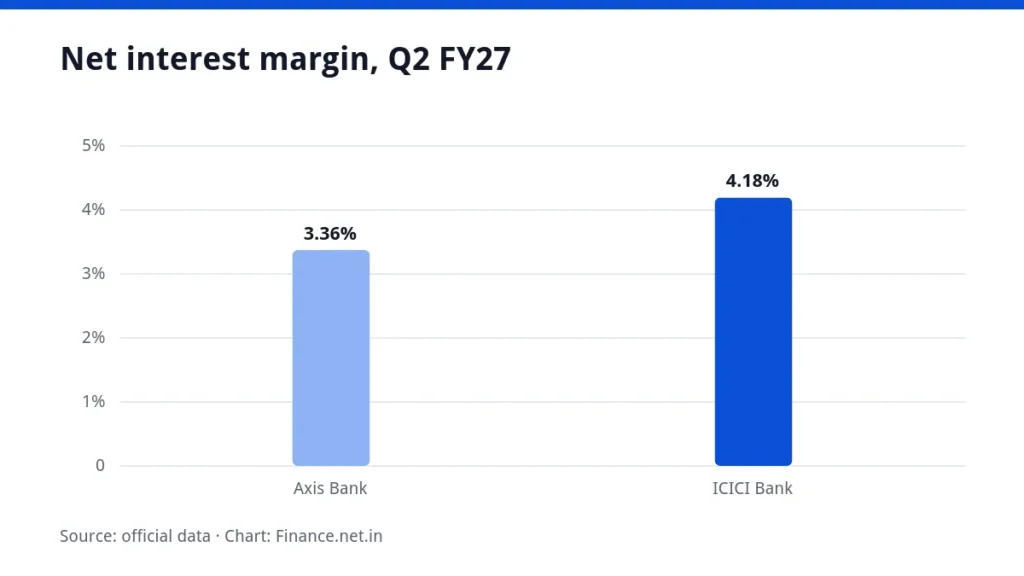
NIM expresses that earning as a percentage of what the bank has deployed in interest-earning assets. A higher figure means the bank keeps more of each rupee it lends after paying for funds. A fall means borrowing costs are rising faster than lending yields, or loan rates are falling faster than deposit rates.
Axis Bank’s NIM was 3.36%, against a market estimate of 3.4% cited by Business Today. ICICI Bank’s NIM narrowed to 4.18% from 4.36% in the previous quarter. According to the Economic Times, the bank expects more pressure in the third quarter from raising foreign currency non-resident bank (FCNR-B) deposits and from branch expansion costs.
NII can rise even when NIM falls, because the loan book is growing. That is why both numbers matter.
Non-performing assets (NPA)
A loan turns into an NPA when the borrower stops paying interest or instalments for long enough that the bank must classify it as bad. The gross NPA ratio is bad loans as a share of total loans. Lower is better.
Axis Bank’s gross NPA ratio was 1.16%, down 30 basis points (0.30 percentage point) from a year earlier. Times of India reported ICICI Bank’s at 1.20%.
Banks also set aside money, called provisions, to absorb possible losses. Axis Bank’s provisions and contingencies were ₹1,694 crore for the quarter. Its provision coverage ratio, which compares provisions with gross bad loans, was 164%. Credit cost, the annualised provisioning charge against loans, was 0.45%.
CASA ratio
CASA stands for current account and savings account. These deposits usually pay little or no interest, so they are a cheaper source of funds than term deposits (fixed deposits). A higher CASA share generally helps a bank’s margin.
CASA deposits made up 36% of Axis Bank’s total deposits. Its term deposits grew 27% year on year, faster than savings deposits at 12%, which shows how the mix can shift.
What it means for you
If you hold a bank’s fixed deposit or savings account, NIM and CASA hint at how much room the bank has to pay for deposits. A lender with a thin margin may be less keen to push up deposit rates. A fall in NPAs suggests fewer loans going bad.
If you are a borrower, a fall in a bank’s margin does not by itself change your loan rate. Rates depend on the bank’s lending policy and RBI’s moves. You can test how a rate affects you with the EMI Calculator or compare deposit options on the FD Calculator.
A worked example, with illustrative numbers: if a bank earns ₹100 on loans and pays ₹60 on deposits, its net interest income is ₹40. Whether that is a good margin depends on how large the asset base was.
Background
Banks report quarterly results to stock exchanges, and the second quarter of FY27 covers July to September 2026. Axis Bank’s balance sheet grew 22% to ₹20,46,240 crore and its advances grew 23% to ₹13,73,727 crore. HDFC Bank, also reporting on Saturday, posted a net profit of about ₹19,510 crore, up roughly 5%, with NII up 10%, according to the Economic Times.
Read our full coverage of Axis Bank’s results and ICICI Bank’s results.
What to watch next
ICICI Bank has flagged further margin pressure in the October-December quarter. Look at NIM, CASA share and gross NPA together rather than profit alone when other banks report.