
What happened
The Reserve Bank of India (RBI) has issued two circulars, A.P. (DIR Series) Circular No. 25 and No. 26, tightening rules for rupee foreign exchange derivatives. The central bank said the steps are meant to keep the foreign exchange market orderly, given evolving conditions. The press release was published on 10 October 2026.
A foreign exchange derivative is a contract whose value depends on a currency rate, such as a forward contract to buy dollars at a fixed rate on a future date. Banks and other entities allowed to deal in foreign exchange are called Authorised Dealers.
The four measures
- No rebooking of cancelled contracts: Authorised Dealers cannot let users rebook any rupee-linked derivative contract, deliverable or non-deliverable, that was cancelled with any Authorised Dealer after the Directions were issued. Rollover on maturity, meaning extending a contract when it expires, is still allowed under existing rules.
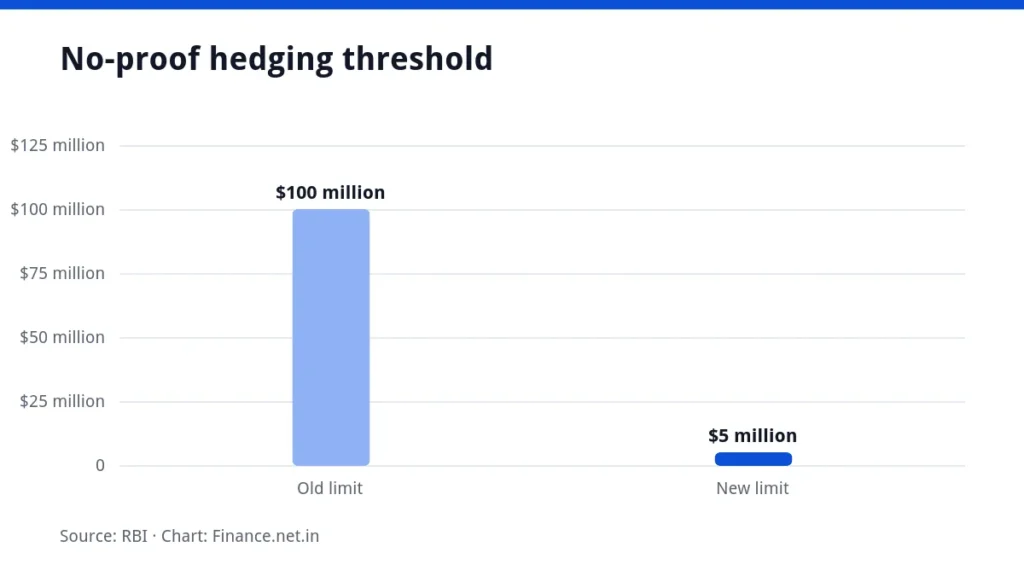
- Lower no-proof threshold: Users could earlier hedge contracted exposures up to $100 million equivalent without establishing an underlying exposure. That is now $5 million equivalent, across all Authorised Dealers. The same cut, from $100 million to $5 million, applies to positions in exchange-traded currency derivatives involving the rupee, across all Recognised Stock Exchanges taken together.
- Extra paperwork: Users hedging contracted exposures must give a written undertaking that the same underlying exposure has not been hedged with another Authorised Dealer. Banks must obtain and keep it.
- Foreign Exchange Risk Reserve (FERR): For rupee derivative contracts with a notional value above $2 million equivalent, Authorised Dealers must hold a cash reserve with the RBI equal to 20% of the rupee equivalent of each transaction’s notional amount. Notional value is the full face amount of the contract, not the money actually at risk. This applies to contracts hedging current account exposures where the user buys foreign currency against the rupee.
What it means for you
The rules mainly affect companies, importers and other users of currency hedges, and the banks that serve them. Most individuals do not trade these contracts directly, though those who trade currency futures on exchanges are covered by the lower $5 million limit. Read more on futures and options to see how such contracts work.
Users who want to hedge more than $5 million equivalent will now need to show a real underlying exposure, such as an import bill. Those who hedge through more than one bank will have to declare that the same exposure is not covered twice.
The FERR is likely to make large hedges costlier for banks to offer, because cash must be parked with the RBI. The sources do not say how banks will pass this on, so any effect on pricing remains to be seen. For example, on a contract with a notional value of ₹10 crore, a 20% FERR would mean ₹2 crore held in cash with the RBI.
If you track the rupee against other currencies, you can check conversions with the currency converter.
Background
The RBI said the measures are intended to strengthen market discipline and risk management while keeping the market orderly and transparent. It did not specify in the release which market conditions prompted the move, and this article does not speculate on that.
What to watch next
Details of how Authorised Dealers apply the Directions, and how users adjust their hedging, will become clearer as banks implement the circulars.