The Reserve Bank of India has signalled that borrowers should not expect cheaper loans soon. At the post-policy press conference on October 7, 2026, Governor Sanjay Malhotra said the central bank had changed its policy stance to make clear that a rate cut is off the table in the near term, after a rate hike at this meeting.
The edited transcript of the briefing, the fourth of financial year 2026-27, was published by the RBI on October 10.
What happened
Asked whether a larger 50 basis point hike had been considered, Malhotra said the committee discusses all possibilities before deciding. A basis point is one-hundredth of a percentage point, so 25 basis points equals 0.25%.
He said even a 25 basis point hike adjusts the real rate, which is the interest rate after subtracting inflation. Whether more tightening is needed, he said, is a call for the Monetary Policy Committee (MPC).
“We have clarified by changing the stance that there is no rate cut in the near term,” Malhotra said.
He added that the RBI is weighing “either a pause or a rate hike”, and that the size of any further increase will depend on how growth and inflation evolve.
Inflation is the main worry
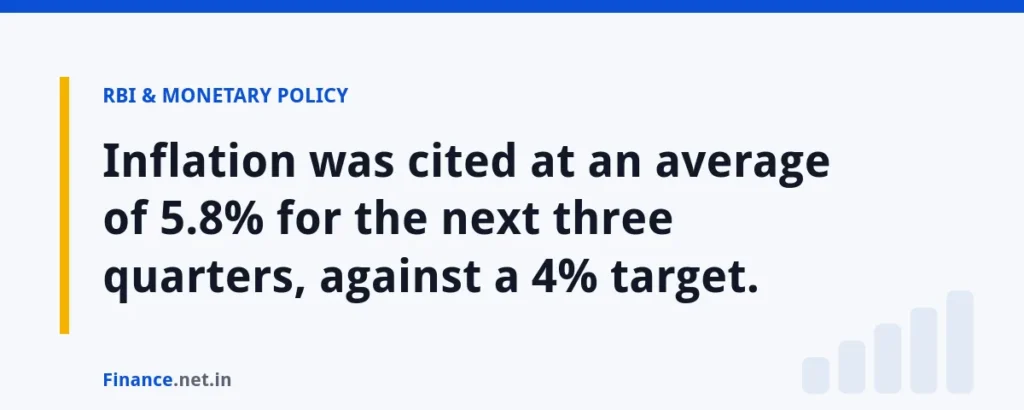
A journalist at the briefing noted that the Governor’s statement put average inflation for the next three quarters at 5.8%. That is well above the 4% headline target set by the government.
Malhotra said the RBI remains focused on bringing headline inflation to 4%, but does not look at that number alone. Much of the recent rise, he said, comes from base effects (a low reading a year earlier making the current rate look higher) and supply-side factors. So the RBI also tracks core inflation, which strips out volatile items, and diffusion indices that show how widely price rises are spreading.
What it means for you
If you have a floating-rate home loan or other loan linked to the policy rate, a hike usually feeds into higher interest costs over time, either through a bigger EMI or a longer tenure. With the RBI saying the next step is a pause or another hike, rates are unlikely to ease soon.
For example, on an outstanding ₹30 lakh loan, a 0.25 percentage point rise adds roughly ₹7,500 a year in interest on that balance, before accounting for repayments that reduce the principal. Your actual change depends on your lender and loan terms.
On the other side, savers may see deposit rates stay firm while the RBI holds a tightening bias. How quickly banks pass this on varies.
Background
Credit demand has been unusually strong. A reporter put bank credit growth at almost 19%, and Malhotra said it is among the highest in the data available. He expects it to stay strong and keep supporting growth, adding that a few percentage points of slowdown would not matter much overall.
Bank lending to non-banking financial companies (NBFCs) has grown about 37%, the Governor said. He said the RBI does not see asset quality concerns at NBFCs now, but stays alert to such risks and to demand and price pressures building up.
On global factors, including US Federal Reserve policy, Malhotra said decisions are driven mainly by domestic growth and inflation. External conditions do affect India’s growth, inflation and interest rates, he said, and are always considered.
What to watch next
The RBI has tied its next decision to incoming data on inflation and growth. Readings of core inflation and how widely price rises spread will be key signals of whether the MPC pauses or tightens further.