
What happened
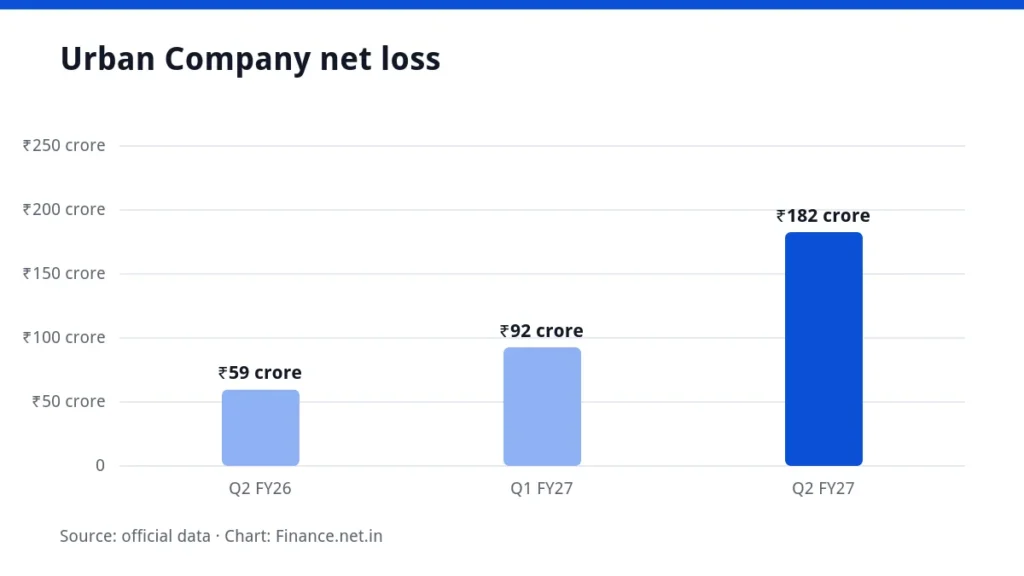
Urban Company reported a net loss of about ₹182 crore for the September quarter (Q2 FY27), up from ₹59 crore a year earlier and ₹92 crore in the June quarter. The results came after market hours on Friday, 16 October 2026, according to reports in the Economic Times, NDTV Profit and CNBC-TV18.
Revenue from operations grew 41% year-on-year to ₹537 crore. Net transaction value (NTV), the total value of services and products sold through the platform, rose 39% to ₹1,432 crore. Orders delivered grew 103% to 15.1 million, and annual transacting users rose 35% to nearly 10 million.
The widening loss comes from spending on InstaHelp, the company’s quick home services business. Consolidated adjusted EBITDA (a measure of operating profit before interest, tax, depreciation and some other items) was a loss of ₹144 crore, which includes ₹174 crore invested in InstaHelp. Excluding InstaHelp, adjusted EBITDA rose 213% to ₹30 crore.
Fundraise
The board approved raising up to ₹2,500 crore, subject to shareholder approval. CNBC-TV18 reported it would be through equity and convertible securities. The company said the money would give it flexibility for investments across businesses, strengthen its position in InstaHelp and fund selective acquisitions. It had cash and treasury investments of ₹1,901 crore at the end of the quarter.
What it means for you
If you use the app, the numbers show demand is still growing quickly, including in smaller cities, where NTV grew around 37%. The company also said average monthly net earnings of active service professionals were ₹30,708 in the first half of FY27, about 10% higher than ₹27,950 a year earlier, based on roughly 97 hours of work a month including travel time.
If you follow the stock, the quarter shows faster growth alongside deeper losses from one new business. Urban Company shares closed 1.74% higher at ₹157 on 16 October, before the results were announced.
Core India business
India Consumer Services, excluding InstaHelp, grew NTV 26.3% to ₹963 crore. Its adjusted EBITDA was ₹34 crore, or 3.5% of NTV, against 2.4% a year earlier, a gain of 110 basis points (1.1 percentage points).
InstaHelp
InstaHelp fulfilled 6.2 million orders, up 63% from the previous quarter, and its NTV rose 34% sequentially to ₹71 crore. The average net value of an order slipped to ₹114 from ₹138, which the company put down to rivals’ competition and discounted first-time offers. The adjusted EBITDA loss on each order narrowed to ₹279 from ₹346 in the June quarter.
International and Native
International NTV rose 66% to ₹267 crore, or 52% in constant currency (adjusting for exchange-rate moves). Revenue rose 82% to ₹75 crore. Margin improved 190 basis points to 2% of NTV. The company said its UAE operations had bounced back after being hit by the conflict earlier this year. In Saudi Arabia, its joint venture Yammak, with SMASCO, saw NTV rise 153% to ₹93 crore, and its adjusted EBITDA loss narrowed to ₹16 crore from ₹20 crore.
Native, its home products business, grew NTV 35% to ₹132 crore, while revenue climbed 40% to ₹105 crore. Operating losses there shrank to 6.8% of NTV from 9% a year before. The board gave in-principle approval to explore residential air conditioners as a new Native category.
Background
The company’s stated goal is to stop losing money at the adjusted operating level by the December quarter of FY28, and to reach ₹1,000 crore of adjusted EBITDA by FY31. It said its consolidated NTV has grown around 40% year-on-year for three straight quarters.
What to watch next
Because festive e-commerce sales fall in the December quarter, the company is guiding for Native NTV to grow 50-55% year-on-year when the second and third quarters of FY27 are taken together. Shareholder approval for the fundraise is also pending. To follow market moves, see our explainers on the Sensex and Nifty 50.