What happened
Deloitte India expects the Indian economy to grow 7.1-7.3% in the current financial year, 2026-27 (FY27), according to its latest Economic Outlook released on Friday, 16 October 2026. For FY28, it sees growth easing to 6.6-7.0%.
The firm says a sustained revival in private investment could add a fresh source of demand and build the productive capacity the economy needs later. Its chief economist, Rumki Majumdar, noted that for the last ten years, growth has leaned mainly on household spending and public spending on infrastructure.
Signs of an investment pickup
Gross fixed capital formation (GFCF), which measures spending on assets such as factories, machinery and buildings, grew 11.9% in the first quarter of FY27. Deloitte says that is its fastest expansion in four years.
- Capacity utilisation, the share of installed capacity actually in use, has averaged above 75.7% for six consecutive quarters. With less spare capacity, companies have more reason to build new facilities.
- Lending to industry has grown at a record 20%, and smaller businesses (micro, small and medium enterprises) are asking for credit at a quicker pace.
- Capital goods production, machinery orders and equipment purchases suggest some investment decisions are moving towards implementation.
The report points to semiconductors, electronics, defence manufacturing, clean energy and artificial intelligence infrastructure as areas that could add to private capital spending, since they need large upfront outlays.
What it means for you
The forecast is a view on the overall economy, not a prediction for any one sector or company. Still, steady private investment tends to support hiring, business credit demand and industrial activity.
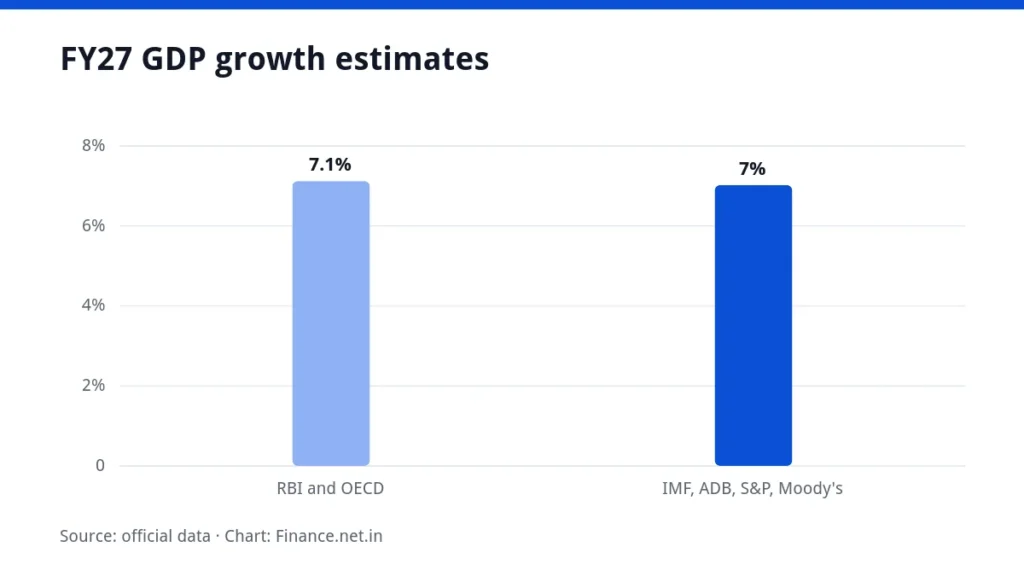
Deloitte’s range sits close to other estimates. The RBI and the OECD both project 7.1% for FY27. Four other bodies, the International Monetary Fund (IMF), the Asian Development Bank (ADB), S&P Global Ratings and Moody’s, are at 7%.
The report cautions that geopolitical tensions, energy-price volatility and trade disruptions remain risks. Shocks to commodity prices, shipping and tariffs have delayed big investment decisions in recent years, it says.
For plans to become working projects, Deloitte points to practical conditions: quicker access to land, approvals that companies can count on, dependable power and water supply, and contracts that are enforced in practice. It adds that state and local governments have a role, and that better logistics and port access could support industrial clusters.
Background
Private investment has taken longer than expected to recover, Deloitte notes, despite better connectivity, business conditions and corporate balance sheets. Majumdar said the next step, converting those gains into lasting investment, rests on how much confidence companies have when planning, funding and carrying out their projects.
Gross Domestic Product (GDP) is the total value of goods and services produced in the economy. You can read more in our explainer on what GDP is, and in our coverage of the IMF’s view on India’s revised GDP method.