
What happened
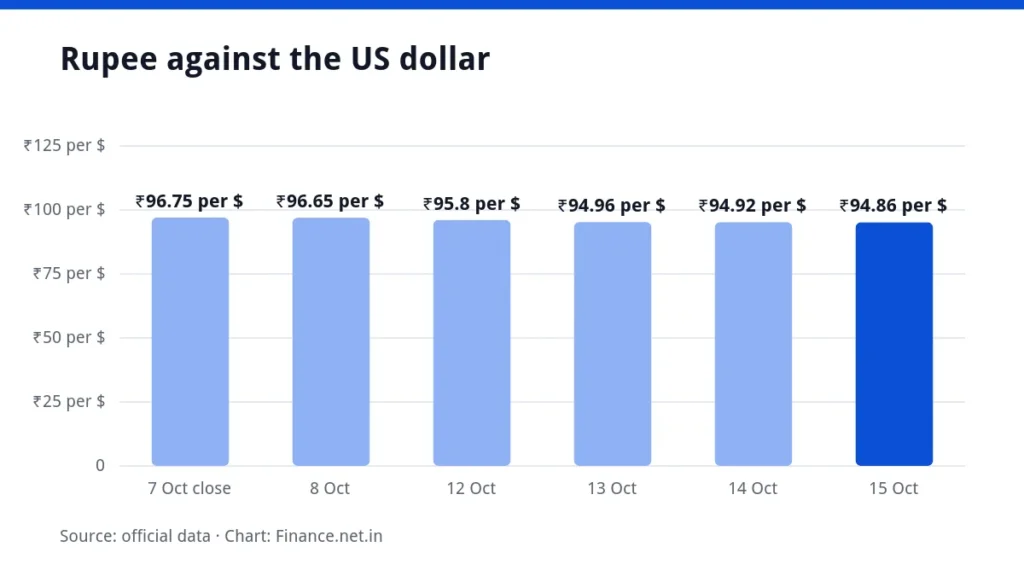
The rupee rose 31 paise to 94.86 against the US dollar in early trade on Thursday, 15 October 2026, according to The Hindu. A paisa is one hundredth of a rupee, so a gain of 31 paise means a dollar costs 31 paise less.
The move extends a sharp recovery. On 7 October the rupee closed at 96.75. On 8 October it edged up 10 paise to 96.65 in early trade, and on 12 October it jumped 91 paise to 95.80. On 13 October it gained 82 paise to 94.96, as reported by The Hindu.
On Wednesday, 14 October, the rupee rose 44 paise to 94.92 in early trade, its fourth straight session of gains, according to The Hindu and BusinessLine. It had closed at 95.36 on Tuesday.
The RBI measures
BusinessLine, citing PTI, reported that over the weekend the Reserve Bank of India (RBI) announced steps to stem the rupee’s fall:
- A special window for oil marketing companies, which takes their dollar demand away from the spot market (where currencies are exchanged for immediate delivery).
- Tighter rules on forex derivatives trades, to curb speculative bets against the rupee.
- A requirement for banks to maintain a 20% reserve for dollar purchases above $2 million.
Forex traders quoted by The Hindu said these measures are expected to reduce dollar demand.
What it means for you
A stronger rupee makes imports, including crude oil, cheaper in rupee terms, and lowers the rupee cost of overseas travel, education fees and dollar payments. If you send money to India, the same dollar now fetches fewer rupees than it did at 96.75. You can check conversions with the Currency Converter.
The recovery is not settled. Forex traders said the rupee remains under pressure from global dollar strength and costly oil. The dollar index, which tracks the dollar against a basket of six currencies, was at 102.11 on 14 October. Brent crude, the global oil benchmark, traded at $106.29 per barrel that day, amid concerns over supply disruptions around the Strait of Hormuz.
Forex traders also noted that USD/INR, the rupee price of one dollar, had gained nearly 2% in the three sessions before 14 October. They said a sustained move below 95.00 could open the way toward 94.50, but external pressures are likely to temper further gains.
Background
The rupee had been weak for months. On 8 October, The Hindu reported that foreign fund outflows continued and that India’s foreign exchange reserves had fallen by $50 billion in three weeks from a September high of $786 billion. Foreign institutional investors sold net equities worth ₹6,121.37 crore on 7 October.
Finance Minister Nirmala Sitharaman said on 13 October that the rupee had depreciated significantly over the past year and a half. She said the RBI will keep working to prevent excessive volatility and that most of the swings stem from external challenges.
Inflation is also in focus. The Hindu reported that wholesale price inflation (WPI) accelerated to 11.39% from 9.92%, with food inflation at 8.66%, while consumer price inflation (CPI) was 5.54%. A forex analyst quoted there said this makes it very difficult for the RBI to turn dovish, meaning to favour easier policy.
What to watch next
Oil prices, the dollar index, foreign fund flows and any further RBI steps are the factors traders are tracking. On equities, the Sensex was at 73,000.82 and the Nifty at 22,688.75 in early trade on 14 October, both slightly lower.