What happened
ECB President Christine Lagarde told the International Monetary and Financial Committee (IMFC) on 17 October 2026 that the euro area has held up well despite an energy shock, while inflation is running above target. She spoke at the fifty-fourth meeting of the committee, held during the IMF Annual Meetings.
Headline inflation, which measures the overall rise in consumer prices, rose to 3.8% in September. The ECB said this mostly reflects a surge in energy prices, and to a lesser extent higher food and services prices. Core inflation, which strips out volatile items, edged up to 2.5%.
Rates and the outlook
The Governing Council raised the key ECB interest rates by 25 basis points in September, after an increase of the same size in June. A basis point is one-hundredth of a percentage point, so 25 basis points is 0.25 percentage point.
Lagarde said the energy shock is too large to “look through”, but that a measured response remains appropriate. She noted that long-term interest rates have risen notably since the last meeting, which tightens financing conditions and should slow growth and reduce price pass-through by more than projected in September. Future decisions will rest on incoming data.
Because of costlier energy, the ECB expects consumer price growth to stay far above its goal until at least the first half of 2027. It should ease after the first quarter and settle near the goal towards the end of 2027. Risks to inflation lean upwards, mainly because of the Middle East conflict and the war in Ukraine.
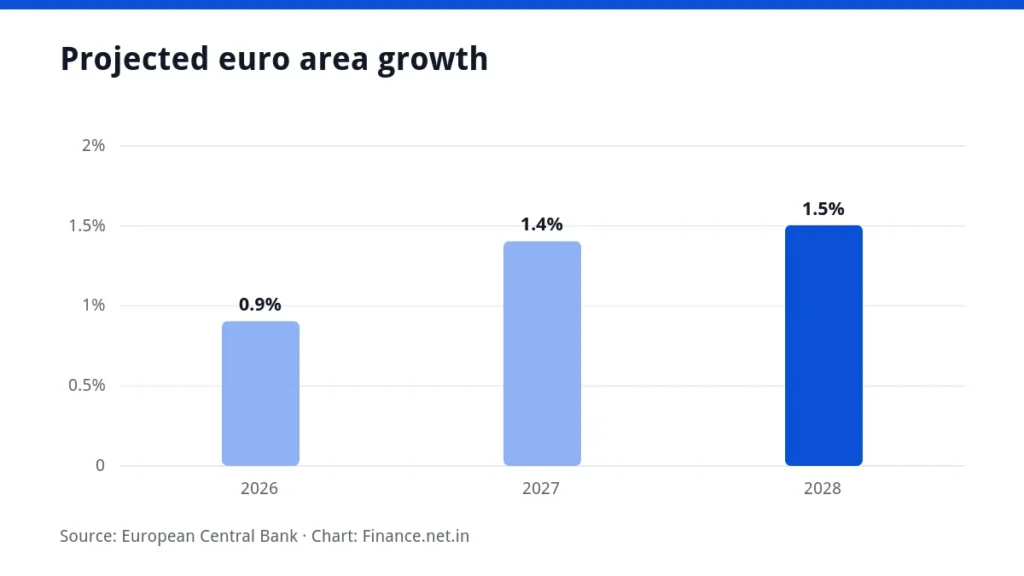
| Year | Projected euro area growth |
|---|---|
| 2026 | 0.9% |
| 2027 | 1.4% |
| 2028 | 1.5% |
Financial stability and payments
Lagarde said euro area banks hold strong capital and liquidity buffers. She flagged risks from concentrated AI-related exposures among non-bank lenders and from cyber threats. Private credit funds have seen outflows and have reactivated redemption gates, but euro area institutions have limited direct exposure, so private credit alone is unlikely to cause instability for now.
On payments, the Eurosystem plans a 12-month internal pilot of the digital euro in the second half of 2027. This depends on adopting the digital euro regulation by the end of 2026. Its new tokenised-asset settlement system, Pontes, went live on 21 September.
What it means for you
The statement describes euro area conditions, not Indian ones, and it does not mention India. For readers, it shows that a major central bank is still tightening in small steps because of energy-driven inflation, while saying its path depends on data.
If you hold euro-denominated income or savings, or plan transfers, higher euro area rates and inflation are part of the backdrop. You can check conversions with the currency converter. The statement does not say how the euro will move.
Background
Central banks set a policy interest rate, such as the repo rate in India, to influence borrowing costs and prices. The ECB says it weighs three things when deciding on rates: the inflation outlook and its risks, how prices excluding temporary swings are behaving, and how effectively its rate moves reach the economy.
Lagarde also welcomed the completion of three IMF reviews and said more than 30 central banks have expressed interest in EUREP, the Eurosystem repo facility for central banks, in the past six months.